Why am I so stressed and how can I handle it?
Mental Health, Fight-or-flight Response, Physiology Of Stress
Why am I so stressed and how can I handle it?
(bestbeyond50.co.uk/post/body-thinks-inbox-sabre-tooth-tiger
Short answer: probably more than you realise — stress hides in your body long before it registers in your mind, and there’s a simple physical check that usually gives you the honest answer.
Here's how to read the signals, and what actually helps.
Ask me if I’m stressed and, most days, I genuinely can’t tell you straight away. That’s not me being evasive — it’s apparently how a lot of us are built. Stress is a notoriously hidden issue; our bodies camouflage it rather than announce it. For me, the tell is my stomach. I can measure exactly how stressed I am by how many times I’ve been to the toilet that day. It sounds unglamorous, but it’s honest, and it’s not just me — the gut is one of the most reliable places stress shows up before your conscious mind catches up.
Why does my body react to stress like this?
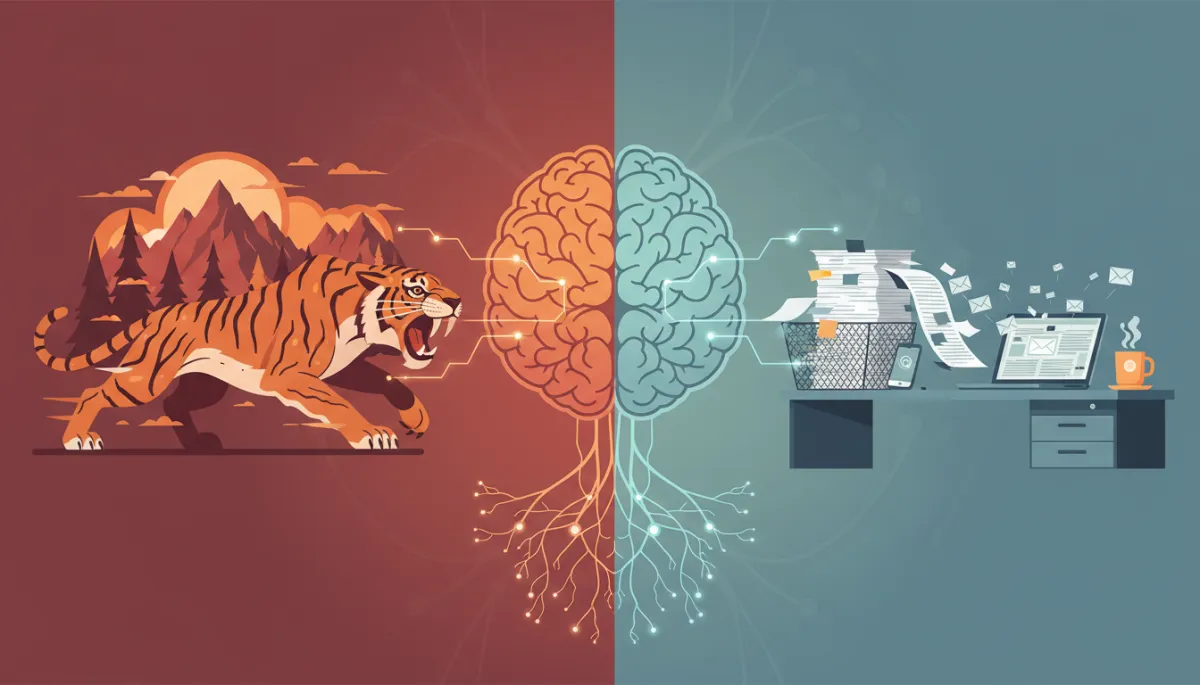
Long before deadlines and overflowing inboxes, the fight-or-flight response evolved to keep humans alive in the face of real, physical danger. Imagine locking eyes with a predator — in a fraction of a second, your nervous system launches a survival protocol to help you run or fight. That same protocol is still running in your body today, just aimed at very different “tigers.”
Your autonomic nervous system has two branches: the sympathetic, which is your body’s accelerator (fight-or-flight), and the parasympathetic, your brake (rest, digest, repair). When your brain senses a threat, the amygdala sounds the alarm, triggering a cascade that releases adrenaline and cortisol — hormones built to help you survive, not to help you relax.
What does stress actually feel like in the body?
Once triggered, the changes are specific, whether the cause is a predator or a push notification: heart rate and blood pressure rise, breathing gets faster and shallower, digestion slows right down, muscles tense, and attention narrows to fixate on the threat. Useful if you’re sprinting from danger. Considerably less useful when the “danger” is a full calendar and a stack of unanswered emails — and that’s exactly when it can show up as the stomach issues, disrupted sleep, or constant sense of being “on edge” that so many of us live with without naming it as stress.
Why can’t my body tell an email from a real threat?
Here’s the key: your nervous system responds toperceivedthreat, not just physical danger. It doesn’t distinguish a genuine emergency from a passive-aggressive email — it just asks, “do I feel unsafe or overwhelmed right now?” If the answer is yes, the same ancient alarm goes off, even sitting perfectly still in a comfortable chair. Because your physiology evolved for short, sharp threats, it treats today’s constant low-grade digital stressors as if they were life-or-death, especially when they pile up without a break.
What actually helps?
Once you understand what your body is doing, you can work with it instead of against it:
•Slow, deep breathing— long, gentle exhales activate the parasympathetic “brake.”
•Movement— a short walk or stretch helps your body use up the stress chemistry it’s already prepared.
•Meditation or simple relaxation practices— even ten minutes can measurably shift how your nervous system is running.
•Talking to someone— sharing a problem with a friend or your community isn’t a weakness, it’s one of the most effective regulation tools there is. Stress that stays unspoken tends to stay in the body; stress you’ve said out loud tends to loosen its grip.

Your brain reacts to emails and predators with the same survival circuitry.
Reframing stress as information, not failure
The next time your stomach tightens or your chest feels heavy, it’s worth remembering: this is the same ancient response that once helped your ancestors survive genuine predators. It’s not overreacting on purpose — it’s doing its best with outdated information. Reaching out isn’t weakness, and neither is admitting you don’t always know if you’re stressed until your body tells you. That’s not a personal failing. It’s just being human, in a very modern world.
If untangling where your own stress is really coming from feels like part of a bigger picture right now, our freeSecond Chapter Confidence Quizhelps you see it clearly.
👉[Take the Second Chapter Confidence Quiz →]
FAQ
How do I know if I’m actually stressed, if I can’t consciously tell?Watch your body rather than your mood — digestive changes, disrupted sleep, jaw or shoulder tension, and frequent minor illnesses are all common physical tells, even when your mind insists everything’s fine.
Is talking about stress with friends actually effective, or just comforting?Both — social connection measurably activates the parasympathetic nervous system, which is why it’s a genuine regulation tool, not just a nice-to-have.
What’s one thing I can do today?Notice your body’s specific stress signal — for some it’s the stomach, for others it’s sleep or tension — and use it as your honest check-in, rather than waiting to consciously “feel” stressed.
